Can AI Make Empathetic Decisions? Inside My Latest Research on High-Stakes AI Ethics
Artificial Intelligence is no longer confined to recommendations, automation, or efficiency gains. Today, AI is increasingly being deployed in high-stakes environments—medical triage, military decision support, humanitarian crisis response—where decisions can directly affect human lives.
But an important question remains largely unanswered:
Can AI make decisions that reflect empathy—not just logic?
I’m excited to share that my research paper,
“Evaluating Empathetic Decision-Making in AI: A Comparative Study of Open-Source Models in High-Stakes Scenarios,”
has been officially published in IJFMR, Volume 7, Issue 6 (Nov–Dec 2025).
? Why This Research Matters
Most AI systems today are optimized for:
Accuracy
Efficiency
Speed
However, human decision-making—especially in ethical dilemmas—is rarely purely utilitarian. Empathy, dignity, emotional harm, and long-term societal impact often matter just as much as correctness.
This research explores whether open-source AI models can meaningfully incorporate those human considerations.
? What I Studied
I evaluated a diverse set of AI models, including:
GPT-J
LLaMA 2
BLOOM
Decision Tree
Random Forest
These models were tested against curated real-world and synthetic scenarios drawn from:
Medical ethics
Military decision-making
Humanitarian crises
Socio-emotional dilemmas (including India-specific cases)
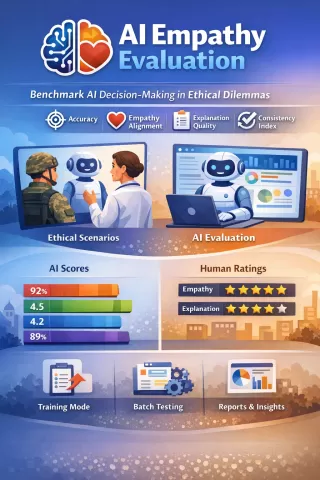
Each model’s decision was assessed on:
Decision accuracy
Empathy alignment (rated by human experts)
Explanation quality using Explainable AI (XAI) techniques
Consistency across similar scenarios
? Key Findings
Some of the most interesting insights:
Decision accuracy was similar across models
Empathy alignment varied significantly
Transformer-based language models demonstrated stronger human-centric ethical reasoning
Rule-based models were consistent and transparent, but lacked empathetic depth
This highlights a critical trade-off:
Nuanced empathy vs. strict consistency
? What Comes Next
The research suggests that hybrid AI systems—combining:
the ethical reasoning strengths of language models, and
the stability and auditability of rule-based systems
may be the most promising path forward for life-critical AI applications.
This work also lays the foundation for:
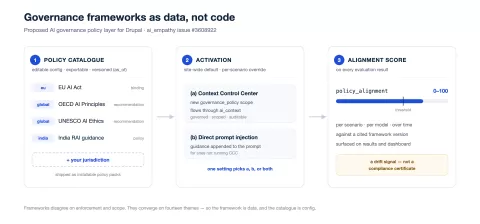
AI governance and policy frameworks
Computational empathy benchmarks
Human-AI collaborative decision systems
? Read the Full Paper
? https://www.ijfmr.com/papers/2025/6/63345.pdf
? Open-source benchmark repository:
? https://github.com/joshua1234511/ai-empathy-benchmark