What's Next for Digital Locker in Drupal: Aadhaar-Verified Sign-In With DigiLocker, and the 2.0 Roadmap
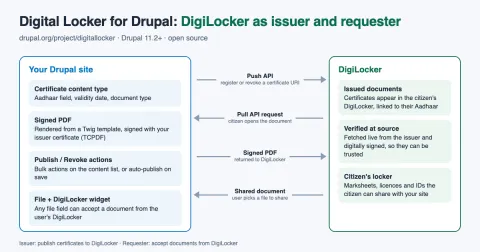
In my last post I introduced Digital Locker, the Drupal module that lets a site issue signed certificates to DigiLocker and accept documents from it. This post is about what comes next: the work that is planned, why it matters, and where you can help.
The headline is a new piece of the module: Sign in with DigiLocker, so a Drupal site can know that an account belongs to a real, unique person, without ever handling Aadhaar authentication itself.
Just landed
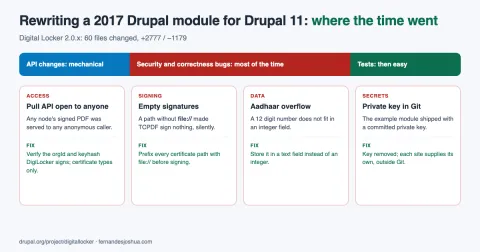
- Drupal 11 rewrite. The 2.0.x branch brought the module up to modern Drupal, with automated tests and a CI pipeline.
- Safer XML handling. The Pull API, the requester and the Push API no longer process XML entity declarations, and any message that contains one is rejected (#3286990). DigiLocker never sends them, so nothing changes for real traffic, and new kernel tests keep it that way.
The big one: Sign in with DigiLocker
The problem
Many Indian Drupal sites need to know that an account belongs to a real person, and that one person has only one account: government portals, education platforms, healthcare services, marketplaces, community sites. Aadhaar is the obvious identity backbone, but direct Aadhaar authentication through UIDAI is restricted. Under the 2025 Good Governance amendment, a private entity needs Central Government approval for a specific public-interest purpose, which puts it out of reach for almost every website.
What Drupal has today does not solve this. Existing modules can check that a typed Aadhaar number looks valid, but a valid-looking number says nothing about who typed it.
The practical route: Meri Pehchaan
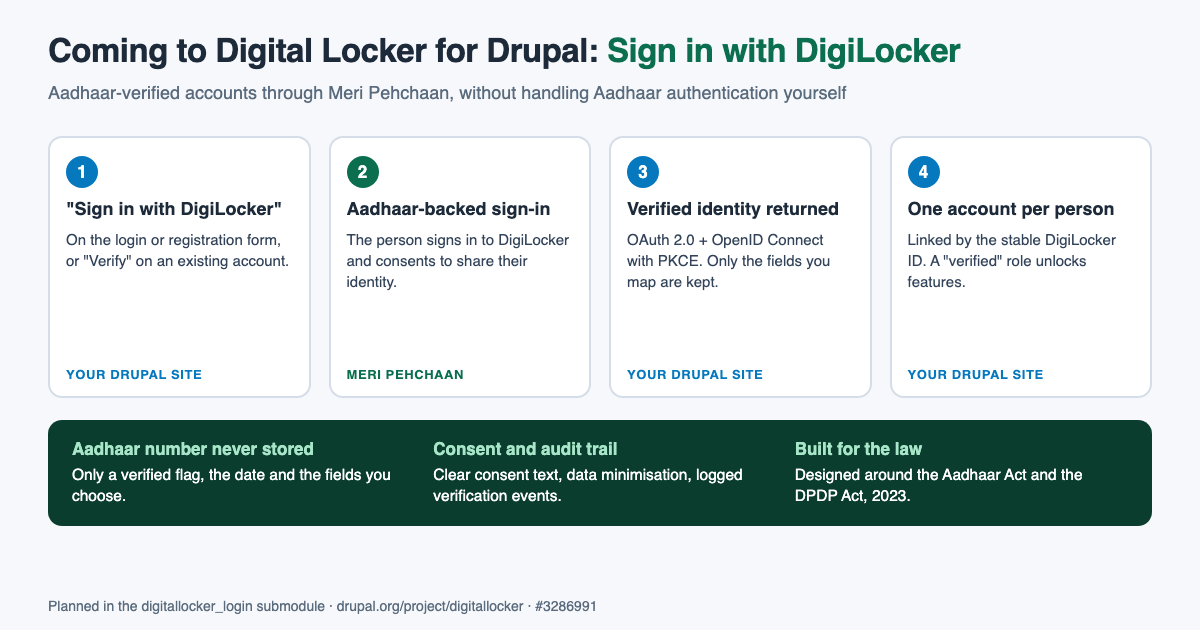
DigiLocker's Meri Pehchaan sign-in uses standard OAuth 2.0 and OpenID Connect, and it is open to registered DigiLocker partners. The person signs in with their Aadhaar-backed DigiLocker account and consents to share their identity. The site receives a DigiLocker-verified identity, and never sees or handles Aadhaar authentication itself.
What the new submodule will do
The plan is a new optional submodule, Digital Locker Login (digitallocker_login), on the 2.0.x branch:
- "Sign in with DigiLocker" on the login and registration forms, using the OAuth 2.0 authorization code flow with PKCE.
- One account per person. Accounts are linked by the stable DigiLocker user ID, so the same identity cannot verify a second account. The link is stored as a keyed hash, not the raw ID.
- Verify an existing account from the user's account page, not only at registration.
- A configurable "verified" role and badge, so a site can gate features such as messaging, listings or applications on verification.
- Settings that keep secrets out of configuration, with a sandbox and a production environment.
Privacy by design
Identity data deserves more care than almost anything else a site stores, so these are rules, not options:
- The Aadhaar number is never stored. Only a verified flag, the verification date, and the profile fields the site owner explicitly chooses to map.
- Clear consent is shown before anyone is sent to DigiLocker.
- Data minimisation: anything not mapped is discarded at the end of the request.
- An audit trail of verification events: linked, verified, removed.
The whole design is aimed at the Aadhaar Act and the Digital Personal Data Protection Act, 2023, so a site that turns this on starts from a compliant position rather than having to retrofit one.
The work plan
The work is tracked in a meta issue, #3286991, split into pieces small enough to review one at a time:
- #3286992 Meri Pehchaan OpenID Connect client
- #3286993 Link accounts by DigiLocker ID and enforce one account per person
- #3286994 "Sign in with DigiLocker" on the login and registration forms
- #3286995 Let existing users verify their account
- #3286996 Verified role and verification badge
- #3286997 Settings form with secrets kept out of configuration
- #3286998 Consent, data minimisation and audit logging
- #3286999 Tests, CI and documentation
Going live needs Meri Pehchaan partner credentials from the DigiLocker partner portal. Development and CI will run against a mocked provider, so anyone can work on the code and run the tests without credentials.
Out of scope, for now
- Direct UIDAI authentication, which needs Central Government approval.
- Aadhaar offline verification and Aadhaar Verifiable Credentials, which need registration as an Offline Verification Seeking Entity. These could be a later phase.
The rest of the roadmap
For issuers
- Protecting Aadhaar numbers on certificates. Certificate types store the recipient's Aadhaar number to push documents to the right person. Masking, encryption and retention guidance for that field are next, in the same spirit as the login work.
- Verification on the PDF. A QR code and a public verification page, so anyone holding a printout can confirm it is genuine.
- More than nodes. Issue certificates from webform submissions, course completions or other entities.
- No-code workflows. ECA events and actions, so a certificate can be issued when a learner passes a course or an application is approved.
- A Drupal recipe that sets up a certificate content type, Pathauto pattern and permissions in one step.
- A new PDF engine. The TCPDF library the module uses has been deprecated by its author in favour of tc-lib-pdf, so signing will need to move over.
For requesters
- Richer document data. With the user's consent, read details from a shared document into form fields instead of only attaching the file.
For everyone
- A first tagged release of 2.0.x, then a stable release with security advisory coverage.
- Drupal 12 readiness, which the CI pipeline already checks against.
How you can help
- Tell me your use case. If you run a portal, a college site, a marketplace or a community site that needs verified accounts or DigiLocker documents, your requirements will shape the design. Comment on the meta issue.
- Review and test. Pick a child issue, review a merge request, or try the 2.0.x branch and report what breaks.
- Share partner experience. If you have been through DigiLocker or Meri Pehchaan partner onboarding, notes on the process would help every Drupal site that follows.
If your organisation needs Aadhaar-verified sign-in or a DigiLocker integration built as part of a larger Drupal project, I work at Axelerant and am happy to connect you with the team. Get in touch.